
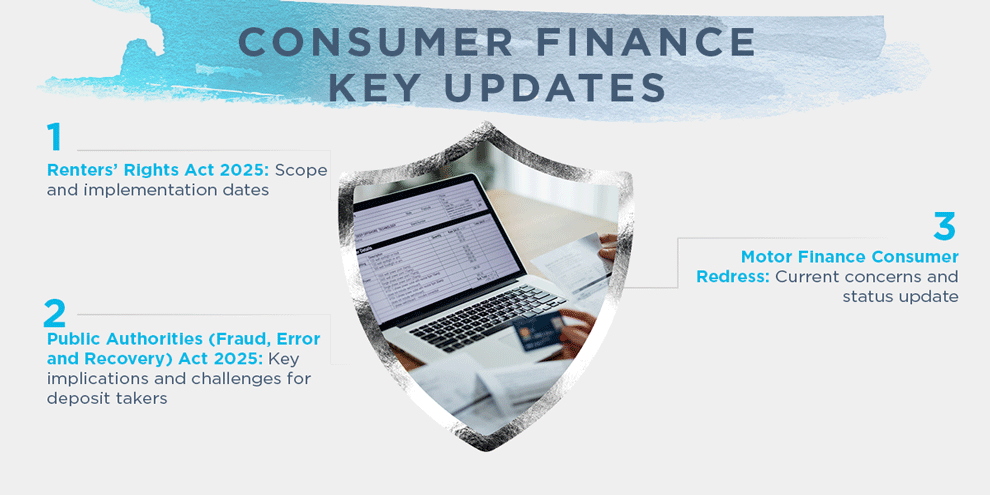
Our latest Consumer Finance regulation update highlights key developments in motor finance and retail insurance.
Renters’ Rights Act 2025: scope and implementation dates
The new Renters’ Rights Act 2025 is a significant legislation marking the greatest increase to renters’ rights in a generation. The Act introduces several implications for lenders, primarily by increasing operational and financial risk for buy-to-let landlords, which can affect the security and value of mortgaged properties and the reliability of loan repayments. The long-awaited changes to the assured tenancy regime will be implemented in phases, beginning at the end of 2025. This article sets out the scope of and timescale for the reforms to be brought into force and the impact for the buy to let sector. Private sector landlords (and their funders) will need to think about how they comply with the new assured periodic tenancy rules and to consider the operating impacts of the new regime.
Read more here on the scope of and timescale for the reforms >
Navigating the Public Authorities (Fraud, Error and Recovery) Act 2025: key implications and challenges for deposit takers
The newly introduced Public Authorities (Fraud, Error and Recovery) Act 2025 will safeguard public money by reducing public sector fraud, error and debt. The Act introduces new powers for relevant Government authorities which will impact authorised deposit takers i.e., banks and building societies. The Act creates several compliance requirements for these institutions to help the authorities to counter public sector fraud.
Read more on the key implications and challenges for deposit takers here >
Motor Finance Consumer Redress- current concerns and status update
The Financial Conduct Authority’s (FCA) recently proposed draft rules for a motor finance consumer redress scheme have attracted considerable scrutiny from across the industry. Stakeholders have voiced a range of concerns, notably the legal basis and proposed time period for the scheme, the rate of compensatory interest, the operationalisation of the scheme, the criteria for redress and whether those criteria have a legal basis, and the short timeframe for the consultation, all of which present significant challenges for firms seeking to respond effectively. In recognition of these issues, the FCA has issued a series of updates and guidance designed to assist firms in understanding the proposals and preparing for the potential implementation of the scheme.
Read more on the current concerns and status of the proposed redress scheme here >
For information on our upcoming training events including our Regulatory Essentials programme, please visit our Financial Regulation page on our website.
Disclaimer
This article is intended for general information purposes only and does not constitute legal advice. For advice specific to your situation, please contact our team at T & M Legis for a consultation with our Legal Experts.