
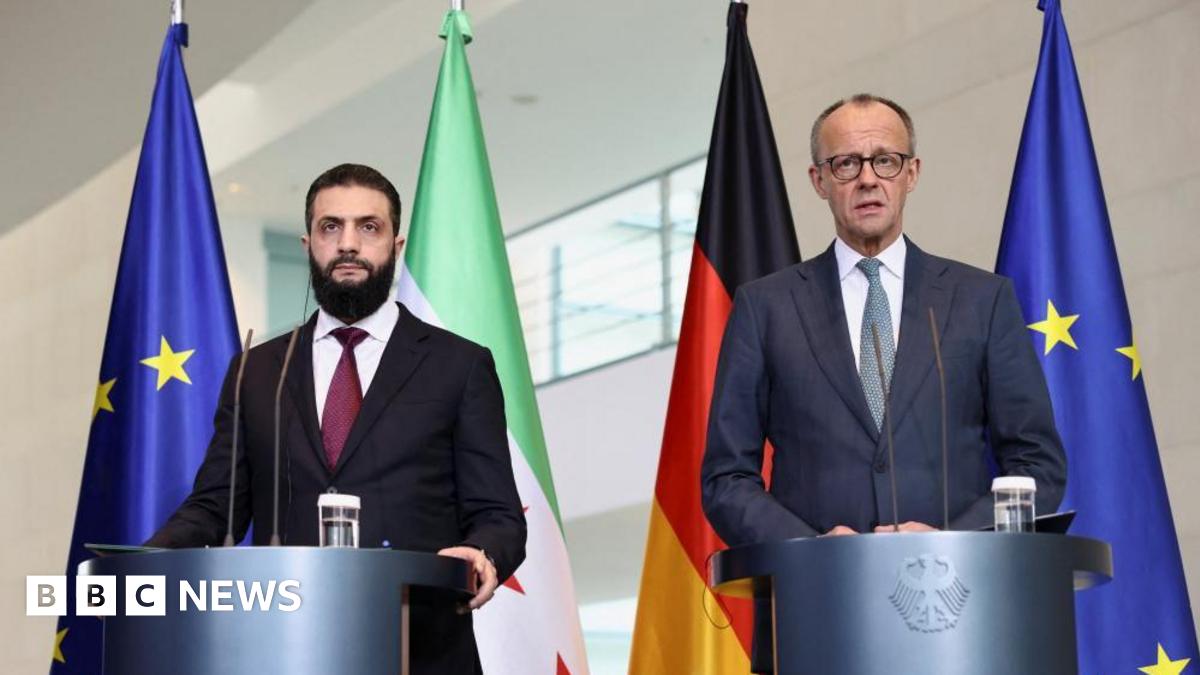
Merz’s government has taken a tougher line on refugees and migrants, amid surging support for the anti-immigration AfD party.
He said initially the priority would be returning "those who no longer have a valid residence rights", especially criminal offenders.
"Looking ahead over the next three years – as Sharaa has expressed his hope – around 80% of Syrians currently residing in Germany are expected to return to their home country," Merz said.
He added that many Syrian refugees had made a major contribution in Germany but that most wanted to return home, where they would play an important role in rebuilding Syria in the years ahead.
Both Merz and Sharaa conceded that some Syrians would stay in Germany.
Merz said it was in his country's interest that Syrian doctors and carers would be able to remain if they wanted to.
Sharaa said Syria would never forget how Germany had opened its doors to refugees during the civil war.
"We are proud that Syrians have learned very quickly to contribute to society," he said. "We are working with our friends in the German government to establish a 'circular' migration model."
This would "enable Syrians to contribute to the reconstruction of their homeland without giving up the stability and lives they have built here, for those who wish to stay", Sharaa said.
But Franziska Brantner from Germany's opposition Green Party said returning to Syria was not an option for many, because of the lack of infrastructure and the unstable security situation there.
She said many Syrians were "deeply anchored" in Germany, holding systemically important jobs and with children in school.
Sharaa's visit has been accompanied by a number of protests.
The Kurdish Community in Germany (KGD) has called on Merz to demand binding commitments regarding the protection of minorities in Syria during the visit. It accuses Sharaa of human rights violations and war crimes.
Sharaa came to power in December 2024 after leading the Islamist rebel offensive that toppled former leader Bashar al-Assad, bringing an end to more than a decade of civil war.
He vowed to reunify Syria, but the country remains deeply divided and has been rocked by several waves of deadly sectarian violence - including recent clashes between government-aligned forces and Kurdish groups in the north-east.
Earlier this year, the government announced the formation of an interim parliamentary body, describing it as a step towards constitutional reform.
However, Kurdish representatives have said the body lacks meaningful representation and accuse Damascus of excluding them from negotiations over Syria's future and failing to provide strong guarantees on minority rights.
This could also be a concern for other groups such as the Druze who are seeking greater autonomy.
Many of the Syrians in Germany came during the refugee crisis of 2015, when former Chancellor Angela Merkel made the decision not to close the borders to those fleeing the civil war.
"Wir schaffen das," she said back then. "We'll manage this." For some of her supporters it was a pragmatic statement of intent.
But it also became a political liability for Merkel. She faced widespread criticism, with many seeing it as an open invitation for mass migration.
Far-right parties, such as the AfD, have since surged all over Europe, campaigning on anti-migrant platforms.
Today, concerns over migration are a major factor in European politics, with many governments imposing much tougher controls.
Additional reporting by Jessica Rawnsley
Disclaimer
This article is intended for general information purposes only and does not constitute legal advice. For advice specific to your situation, please contact our team at T & M Legis for a consultation with our Legal Experts.